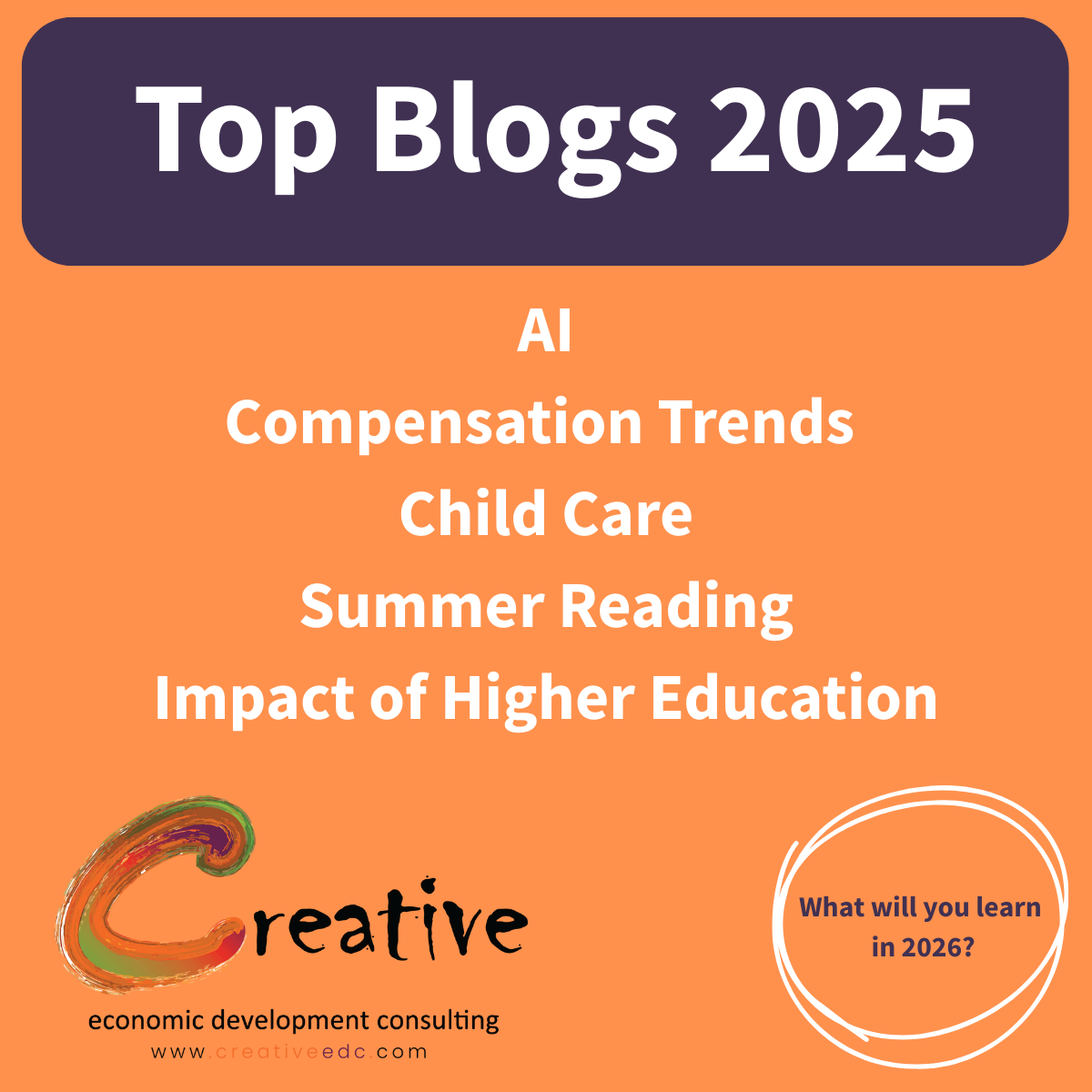
Reviewing the most-read posts on our blog in 2025 point to a clear conclusion: economic development leaders want tools and tactics they can use right now. They are looking for pathways to better decisions, stronger teams, and fewer constraints on growth. They also want to know how information moves, who controls it, and how it can distort decisions.
As organizations continue to ‘right-size’ and turnover creates pressures on time and capacity, AI can compress the first draft cycle for reports, grant narratives, marketing copy, stakeholder briefs, and even meeting preparation. Our July AI post advocated for a clear operating approach: give the tool a role, feed it local context, demand specific formats, iterate, validate sources, and document how you used it to maintain trust. It also highlighted a practical split in adoption. In a discussion at our 2025 WEDN conference, about a quarter of attendees said they did not use AI much, while nearly half said they used it every day. ChatGPT dominated the list of tools people named. This adoption rate has likely accelerated since we asked earlier this year.
That split connects directly to the second most-read topic: compensation and employment trends in economic development. North Carolina’s survey results show a younger, less tenured field than in prior years, with an average respondent age of 45.4 and a sizable share of professionals planning to retire within ten years. The average salary for respondents in North Carolina came in at $102,421, and 85% reported a raise with an average increase of 5.3%. Nearly half reported bonus eligibility, with an average bonus of $7,460. Virginia’s survey showed similar dynamics, with an average age of 44.6, an average salary of $104,335, and widespread raises around 5%, but fewer bonuses. We conduct these surveys as a service to the two states’ economic development communities – and enjoy analyzing and sharing the data they provide.
The third most-read post, on the childcare gap, points to the expansion of the work and considerations of the economic development agenda. Childcare determines whether parents can work, whether employers can staff shifts, and whether young households stay in a community. The post cites a statewide pattern that should get every local leader’s attention: many North Carolina counties face a childcare slot gap of 50% or more. The post includes potential solutions and approaches to address this constraint that is new to many practitioners. The post includes unique case studies and practices that can be adopted in nearly every community.
Measuring and communicating impact – especially to the local and regional economy, is at the heart of economic development. A recent project with Western Carolina University (WCU) was documented in a post in September to look at the anchor institution’s measurable returns. WCU employs more than 2,000 people, spends about $323 million annually on operations and capital, and draws roughly 204,000 visitors a year. The analysis estimates $1.5 billion in statewide impact, $894 million in a 16-county region, and 10,627 jobs supported. It also quantified a $5.61 return for every $1 invested by taxpayers.
Our annual summer reading post is always popular. We included practical and timely offerings relevant to our industry and life in general. Harari’s Nexus focuses on the history of information and how it shapes power. Chris Hayes writes about the economy of attention and the forces competing to capture it in The Siren’s Call. Sutton’s The Friction Project argues that organizations improve when they reduce barriers that block outcomes. These are economic development books, even when they are not labeled that way. Our work depends on information quality, stakeholder attention, and removing friction improves process and outcomes across the board.
If you want a summary of these 2025 posts: build capacity, reduce friction, and defend workforce participation. Here are some actions you can take immediately:
- Adopt an AI standard for your organization: approved use cases, required fact-checking, and clear disclosure practices.
- Benchmark your organization’s pay and benefits, then build a retention plan that includes professional development, mentoring, and succession planning.
- Treat childcare as core infrastructure for labor force participation and explore models that expand supply without waiting for a single large provider.
- Identify and consider quantifying the impact of anchor institutions; communicate their value with visuals and local examples that elected officials can repeat accurately.
- Audit internal “friction” points in your organization and in your programs for businesses. Remove steps that add time but not value.
- Invest in staff learning, either for yourself or your team. Better inputs create better judgment, better writing, and better outcomes.
Most Read Blogs in 2025
Best Practices for Generative AI in Economic Development
Compensation and Employment Trends in Economic Development in North Carolina and Virginia
Creative New Ways to Bridge the Childcare Gap